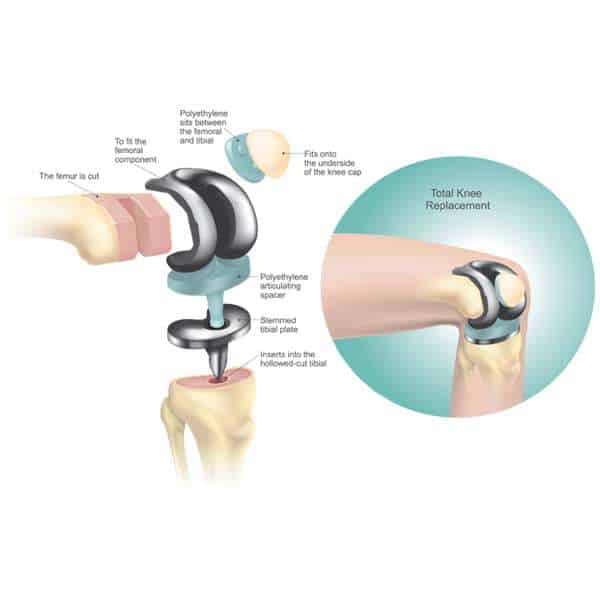
Total knee replacement surgery involves removing the damaged surfaces of the knee joint and replacing them with artificial components. These components include a metal femoral component, a metal and plastic tibial component, and a plastic patellar component. The goal is to create a new, smoothly functioning joint.
The procedure of total knee replacement (TKR) typically follows these steps:
Preparation and Anesthesia: The patient is given anesthesia, which may be general (putting the patient to sleep) or regional (numbing the lower body).
Incision: The surgeon makes an incision at the front of the knee to access the joint.
Resection: The damaged cartilage and bone from the surface of the knee joint are removed. The ends of the femur (thigh bone) and tibia (shin bone) are shaped to fit the prosthetic components.
Implantation: The metal components are placed on the prepared bone surfaces of the femur and tibia. A plastic spacer is inserted between them to allow smooth movement. If necessary, the back of the patella (kneecap) is also replaced with a plastic component.
Closure: The surgeon closes the incision with stitches or staples and covers it with a sterile bandage.
Recovery: The patient is taken to a recovery room for monitoring and then begins physical therapy to aid in recovery and improve joint function.