
Shoulder Replacement Surgery in Ahmedabad, Gujarat
Recreating the Shoulder, Matched to the Rotator Cuff
A shoulder replacement is usually considered when arthritis, a damaged ball of the shoulder or an old fracture causes constant pain, disturbed sleep and difficulty lifting the arm, and treatment without surgery has not helped. The damaged surfaces are replaced with artificial parts, and the type of operation depends mainly on the rotator cuff, the group of tendons that lifts and turns the arm. At PMG Hospital in Gota, Ahmedabad, three types are performed: a total (anatomic) replacement when the cuff works, a partial replacement (hemiarthroplasty) when only the ball is damaged, and a reverse replacement when the cuff is badly torn or an earlier implant has failed. The arm usually rests in a sling for a few weeks, and comfortable overhead reach commonly returns between three and six months.
Types
The Rotator Cuff Decides the Type
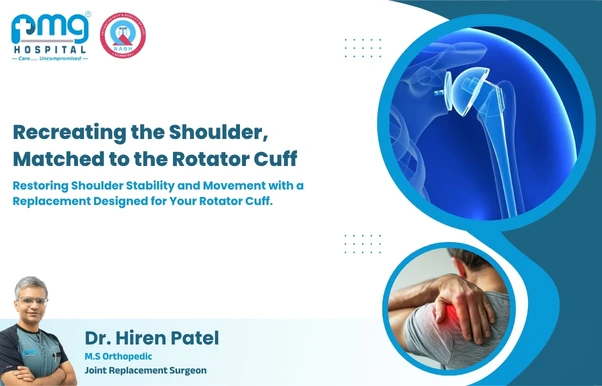
The rotator cuff holds the humeral head steady against the glenoid and helps lift the arm. A working cuff allows a replacement that copies the natural joint. A cuff that is torn beyond repair needs a reverse design, in which the deltoid muscle does the lifting instead.
| Operation | Usually used for | Rotator cuff | What is replaced |
|---|---|---|---|
| Total (anatomic) shoulder replacement | Arthritis of the ball and socket | Working | The ball and the socket |
| Partial shoulder replacement (hemiarthroplasty) | Avascular necrosis or a fracture, with a healthy socket | Working | The ball (humeral head) only |
| Reverse shoulder replacement | Cuff tear arthropathy, a cuff that cannot be repaired, or a failed earlier implant | Torn or not working | The ball and socket, with their positions swapped |
Total Shoulder Replacement
Both the ball and the socket are replaced in a way that copies the shoulder’s natural design. It is used for arthritis when the rotator cuff is intact.
Partial Shoulder Replacement (Hemiarthroplasty)
Only the damaged ball is replaced, usually for avascular necrosis or a fracture when the socket is still healthy.
Revision & Reverse Shoulder Replacement
A reverse design is used when the rotator cuff can no longer do its job, and it is also commonly used when an earlier shoulder replacement has failed.
Causes
Conditions That Lead to Shoulder Replacement
| Condition | What happens to the shoulder |
|---|---|
| Osteoarthritis | The cartilage of the ball and socket wears away while the rotator cuff usually stays intact; reaching behind the back is often the first movement to become difficult |
| Cuff tear arthropathy | A long-standing, unrepairable tear of the rotator cuff is followed by arthritis; the humeral head moves upwards and raising the arm becomes very hard |
| Rheumatoid arthritis | Inflammation damages the joint surfaces and often the rotator cuff as well |
| Avascular necrosis | The ball of the arm bone loses its blood supply and collapses, while the socket often stays healthy |
| Fracture of the upper arm bone | A complex break that cannot be fixed, or one that has healed badly, can leave the shoulder painful and stiff |
| A failed earlier replacement | An implant that has loosened, become unstable or is working against a failed rotator cuff |
Diagnosis
Is It Arthritis, or Something Else?
Many conditions cause a painful shoulder, and most of them are not treated with a replacement. The first step is to find out exactly what is wrong.
| Condition | Usual first treatment |
|---|---|
| Frozen shoulder, which is common in people with diabetes | Time, physiotherapy and sometimes an injection; it usually settles without a replacement |
| Rotator cuff tendinopathy | Exercises with a physiotherapist, adjusting daily activities and, in some cases, an injection |
| A rotator cuff tear that can be repaired | Physiotherapy first; keyhole (arthroscopic) repair if symptoms continue |
| Pain coming from the neck | Treatment of the neck problem |
A replacement is considered when the joint surfaces are worn, as seen on X-ray, and the rotator cuff has been assessed with an MRI scan or CT scan.
Symptoms
Signs That Should Be Checked
- Pain that stops you sleeping on the affected side
- Being unable to lift the arm to shoulder height or above
- Grinding or catching when you turn the arm
- Difficulty reaching behind your back to dress
- Weakness when lifting everyday things such as a kettle or a bucket
- A shoulder that has not been right since an old fracture or an earlier operation
None of these signs means that an operation is needed. They are reasons to have the shoulder examined and the cause found.
The operation
Shoulder Replacement Operation in Ahmedabad: Step by Step
If a shoulder replacement operation in Ahmedabad is planned for you, these are the usual steps at PMG Hospital:
- 1X-rays, a CT scan of the socket and an MRI or ultrasound scan of the rotator cuff are used to choose the type of replacement.
- 2General anaesthesia is usually combined with a nerve block to control pain after surgery.
- 3The shoulder is opened through an incision at the front.
- 4The worn humeral head is cut away, and a stem is seated in the arm bone, carrying a new head (or, in a reverse replacement, a cup).
- 5In a total replacement, the socket is given a polyethylene surface; in a reverse replacement, a ball is fixed to the socket and a cup to the arm bone.
- 6The movement and stability of the new joint are checked before the wound is closed.
Recovery
Recovery and Physiotherapy
| Stage | What usually happens |
|---|---|
| First days | Gentle swinging and assisted movements, with the arm resting in a sling |
| Weeks 3–4 | The sling is usually stopped, depending on the operation |
| Around week 6 | Strengthening exercises begin |
| Weeks 6–8 | Driving again for most people, when the surgeon agrees |
| At least 3 months | Heavy lifting on the operated side is avoided; after some replacements, long-term limits are advised |
| Months 3–6 | Comfortable overhead reach returns for most people |
Each stage of physiotherapy prepares the shoulder for the next one. Doing too much too early can set recovery back, so the programme is followed in order.
Risks
Risks to Discuss Before Surgery
- Infection around the implant
- Stiffness of the shoulder
- The new joint becoming unstable or coming out of place
- Injury to a nerve around the shoulder (uncommon)
- A break in the arm bone during or after surgery
- After some years, the implant may wear or work loose and need to be redone
- In an anatomic replacement, failure of the rotator cuff later on
A 2020 analysis of long-term studies and joint registries found that about 9 out of 10 total and reverse shoulder replacements had not needed further surgery 10 years after the operation. Results over longer periods are more limited.
Cost
Shoulder Replacement Surgery Cost in Ahmedabad
The cost of shoulder replacement surgery in Ahmedabad depends mainly on:
- The type of replacement: total, partial or reverse
- The implant chosen after planning
- The room category and the number of days in hospital
- Scans before surgery, physiotherapy and follow-up visits
A partial replacement usually costs less than a total, and a reverse or revision replacement usually costs more. PMG Hospital gives a written, itemised estimate after the assessment. Check your cover with your insurance provider.
Choosing
How to Choose a Shoulder Replacement Doctor in Ahmedabad
Whichever shoulder replacement doctor in Ahmedabad you consult, it is reasonable to check:
- The surgeon’s medical council registration number
- Qualifications in orthopaedics and training in joint replacement
- Whether the rotator cuff has been assessed on a scan before the type of replacement is chosen
- Whether treatment without surgery has been considered
- The physiotherapy plan after surgery
The care team
Shoulder Replacement Surgery Doctor in Ahmedabad
A shoulder replacement surgery doctor in Ahmedabad is, in practice, an orthopaedic surgeon with training in arthroplasty (joint replacement), who decides between a total, partial or reverse design and carries out the operation. Several other professionals take part at different stages, from the first scans to the last physiotherapy session.
| Doctor or therapist | Their part in shoulder replacement |
|---|---|
| Radiologist | Interprets the scans used for planning: plain X-rays, a CT of the socket, and an ultrasound or MRI of the rotator cuff, which together guide the choice of implant |
| Physician or cardiologist | Looks at blood pressure, heart health, diabetes and regular medicines so that the anaesthesia can be planned safely |
| Anaesthetist | Usually gives general anaesthesia together with a nerve block at the side of the neck (interscalene block), which can leave the arm numb and heavy for some hours after surgery |
| Orthopaedic surgeon | Replaces the worn surfaces, tests the movement and stability of the new joint, and sets the sling period and the limits for the arm |
| Physiotherapist | Guides the staged programme: assisted movement while the arm is in the sling, then exercises you do yourself, then strengthening from about six weeks |
For people with rheumatoid arthritis, the doctor who manages their arthritis medicines is usually asked whether any of them should be paused around the operation, because some of these drugs can slow wound healing or raise the risk of infection.
Surgeon
Who Performs the Operation
At PMG Hospital, Gota, shoulder replacement is performed by:
| Field | Detail |
|---|---|
| Surgeon | Dr. Hiren Patel |
| Qualifications | MBBS, MS (Ortho), International Fellowship in Joint Replacement |
| Medical college | B.J. Medical College, Ahmedabad (MBBS and MS (Ortho)) |
| Role at PMG Hospital | Director & Head Joint Replacement Surgeon |
| Registration | Registered Medical Practitioner; Gujarat Medical Council Reg. No. G-20583 |
| OPD | Monday to Saturday, 10:00 AM to 8:00 PM; Sunday by appointment |
Hospital
Where the Operation Takes Place
Shoulder replacement is carried out at PMG Hospital, Gota, Ahmedabad. Services relevant to shoulder replacement include:
- Orthopaedic OPD: Monday to Saturday, 10:00 AM to 8:00 PM; Sunday by appointment
- Emergency and trauma care, available 24×7
- Physiotherapy at the hospital
FAQs
Common Questions
Shoulder replacement pages: Total shoulder replacement·Partial shoulder replacement (hemiarthroplasty)·Revision and reverse shoulder replacement
Contact
Reaching PMG Hospital
Address
PMG Hospital (PMG Orthopedic Hospital)
3rd Floor, Athena Avenue, B/H Jaguar Showroom, Krishna Hardware Road, Nr. Eulogia Inn Hotel, S.G. Highway, Gota, Ahmedabad, Gujarat 382481
- Phone
- +91 96625 91666
- Phone and WhatsApp
- +91 96627 70141
- OPD
- Monday to Saturday, 10:00 AM to 8:00 PM; Sunday by appointment
- Emergency and trauma care
- 24×7
Get in touch
Call or send your reports, or open the hospital’s location in Google Maps.
Medically reviewed by Dr. Hiren Patel, MS (Ortho.), Joint Replacement Surgeon, PMG Hospital, Ahmedabad.