
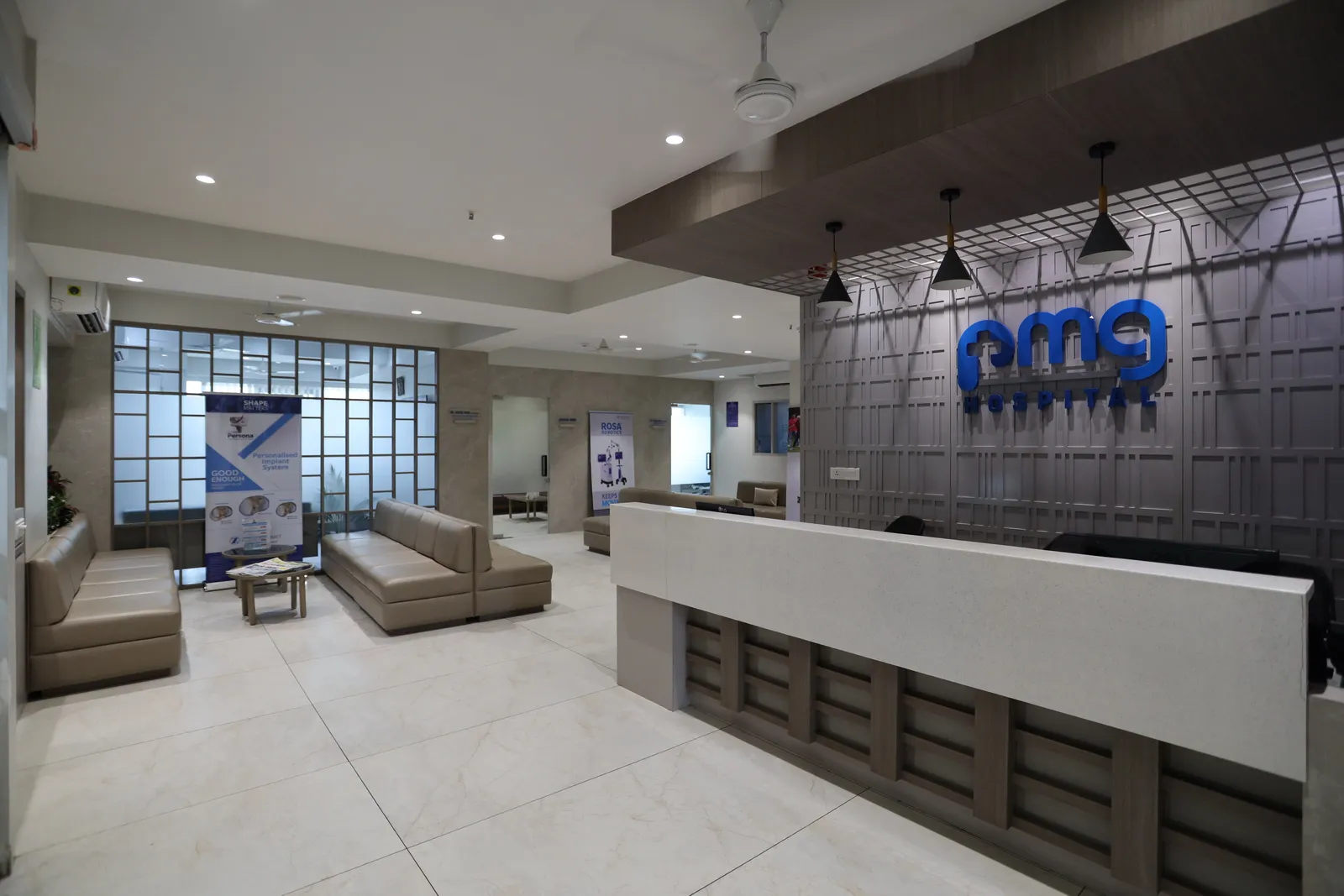
Knee Replacement Surgery in Ahmedabad, Gujarat
Renewing the Knee, Keeping as Much of Your Own as Possible
A knee replacement is usually advised when arthritis pain keeps limiting your walking, stairs or sleep even after medicines, exercises and weight control have been given a fair trial. The surgeon takes away the damaged joint surfaces and fits metal parts in their place, with a smooth polyethylene (medical-grade plastic) bearing between them, resurfacing the underside of the kneecap too if it is worn. At PMG Hospital in Gota, Ahmedabad, three types are performed: a total replacement when the whole knee is worn, a partial (unicondylar) replacement when only one side is affected, and a revision when an earlier implant has failed. After a first-time knee replacement, most people go home in one to four days and, with regular physiotherapy, get back to routine activity in about three to eight weeks.
The operation
What Happens in Knee Joint Replacement Surgery?

In a knee replacement (knee arthroplasty), the surgeon trims away the worn cartilage, shapes the bone ends of the femur and tibia, and fits an artificial joint over them. The new gliding surfaces are made of metal, and a polyethylene (medical-grade plastic) spacer lies between them. A worn patella (kneecap) can be given a new polyethylene surface as well. Ligaments and muscles that still work well are kept wherever possible.
Whichever type is chosen, the operation is planned around the pattern of damage inside your own knee rather than a single standard method.
Types
Which Knee Operation Suits Which Knee?
Everything starts with one question: which parts of this knee are still healthy? Widespread arthritis calls for new surfaces throughout. Arthritis on one side only may leave room to keep the rest. A failed earlier implant needs exchanging.
| Operation | Usually suited to | What is changed | Usual stay |
|---|---|---|---|
| Total knee replacement | Wear throughout the joint, often with a varus (bow-leg) or valgus (knock-knee) deformity | New surfaces on the inner and outer sides of the joint, and on the underside of the kneecap when needed | 2–4 days |
| Partial (unicondylar) knee replacement | Damage on a single side of the joint, while the ACL still holds the knee steady | Just the damaged side gets new surfaces; the two cruciate ligaments stay | About 1–2 days |
| Revision knee replacement | A previous implant that is loose, worn, infected or unstable | Old components come out, missing bone is rebuilt, and new components go in | 5–10 days |
Total Knee Replacement
Chosen when the whole joint is affected. It is the form of knee replacement done most often, and the operation can also straighten a leg that has become bowed or angled.
Partial (Unicondylar) Knee Replacement
Chosen when wear is confined to one side and the ligaments are healthy. Less bone is taken and people are often up and about sooner, though only some knees qualify.
Revision Knee Replacement
Chosen when a knee implant from an earlier operation is no longer working properly. It takes longer in theatre and involves rebuilding bone as well as fitting new parts.
Causes
Why Knees Wear Out
The cause of the damage affects which operation is suitable and how much of the natural knee can be kept.
| Condition | How it damages the knee |
|---|---|
| Osteoarthritis | Cartilage gradually thins until the bone surfaces rub together; this is the most common reason for knee replacement |
| Rheumatoid arthritis | Inflammation of the joint lining damages the cartilage, often in both knees and at a younger age |
| Post-traumatic arthritis | Develops years after a break running into the joint surface, or after a ligament tear that left the knee loose |
| Gout | Repeated attacks of crystal inflammation can erode cartilage; controlling uric acid is part of treatment |
| Previous joint infection | Infection can leave lasting cartilage damage and stiffness |
| Bow-leg or knock-knee | One side of the knee carries more load and wears faster, and that wear makes the deformity worse |
Symptoms
Signs That Point Towards an Assessment
- Knee pain that disturbs your sleep
- Difficulty with the stairs at home
- A walking distance that keeps getting shorter
- Episodes of the knee swelling up, catching or buckling
- Legs that look more bowed or more knock-kneed each year
- Medicines, injections and exercises that no longer give lasting relief
None of these signs means that surgery is needed. An X-ray alone is not a reason to operate either: some people whose X-rays look badly worn still walk comfortably. What matters is how symptoms, the examination findings and the X-rays fit together.
Before surgery
Treatment That Usually Comes First
| Approach | What it does |
|---|---|
| Weight reduction | Lowers the load passing through the knee with every step |
| Thigh-muscle (quadriceps) exercises | A stronger thigh shares the load and can ease pain in earlier arthritis |
| Changes at home | Sitting on chairs rather than the floor, fitting a raised toilet seat, and carrying a walking stick on the side away from the painful knee |
| Pain medicines | Help during flare-ups; anti-inflammatory tablets are not meant for long-term daily use without medical advice |
| Injections into the knee | Can calm a painful phase for some weeks or months, but the arthritis itself remains |
Many people seen in the orthopaedic OPD are advised to continue these measures rather than to have an operation. An operation enters the discussion once these steps no longer keep pain at a level you can live with.
Planning
Knee Replacement Operation in Ahmedabad: Step by Step
At PMG Hospital, planning starts in the OPD, well before the day of surgery.
- 1Standing, full-length X-rays are taken to measure the alignment of the leg.
- 2The implant size is planned on those X-rays.
- 3Fitness for surgery is checked with blood tests and an anaesthesia assessment, along with other tests where needed.
- 4On the day of surgery, a single cut along the front of the knee gives access to the joint; the damaged surfaces are taken off, and temporary trial components show whether the ligaments are balanced through bending and straightening.
- 5The final implant is fixed in place, and alignment is checked again before the wound is closed.
The TriNova Approach
At PMG Hospital, three techniques that can be combined during knee replacement go by the collective name “TriNova”:
| Technique | What it means |
|---|---|
| Robotic assistance (ROSA Knee System) | The system records measurements of the knee during surgery, so the surgeon can compare bone cuts, implant position and leg alignment with the plan. The surgeon performs the operation. |
| Subvastus approach | Access to the joint is made under the lower edge of the vastus medialis (an inner thigh muscle), leaving the quadriceps tendon uncut. |
| Surgery without a thigh tourniquet | No tight cuff is placed around the thigh, so blood keeps flowing to the leg during the operation. |
Each technique is used only where it suits the knee, and the surgeon explains which parts apply to your operation.
Research
Robotic Knee Replacement Surgery: What the Research Shows
The robot available for knee surgery at PMG Hospital is the ROSA Knee System. In a combined analysis of randomised trials, robotic assistance placed implants closer to the planned alignment on X-rays taken after surgery, while function scores and complication rates were similar to those of conventional surgery. Robotic assistance does not replace careful patient selection, and it can add to the cost.
Recovery
Recovery: A Typical Path
| Stage | What usually happens |
|---|---|
| Day of surgery | With a physiotherapist’s help, first steps once the anaesthetic has worn off and it is safe |
| First few days | Knee-bending and thigh-muscle exercises and walking practice with a walker or stick; home after the usual stay |
| Weeks 3–6 | Many people start walking without support |
| Weeks 3–8 | Return to routine activity such as household tasks, outings and visits to the market or temple: often about 3–4 weeks after a partial and 6–8 weeks after a total; work and driving can take a little longer after a partial |
| Months 3–6 | The time often needed for full comfort after a severely deformed knee or a revision |
Risks
Risks to Discuss Before Surgery
- Infection around the implant
- A clot in a deep vein of the leg (deep vein thrombosis), which can occasionally move to the lungs
- Stiffness, which occasionally needs the knee to be bent under anaesthesia
- Pain that persists in some patients despite a well-placed implant
- Damage to a nerve or artery close to the knee (rare)
- The implant wearing or working loose after some years, sometimes requiring a revision
Diabetes, excess weight, smoking and dental infection all raise the risk of infection, so they are dealt with before surgery wherever possible.
Cost
Knee Replacement Surgery Cost in Ahmedabad
- The type of operation: partial, total or revision
- The implant chosen
- Whether robotic assistance is used
- A single knee or both knees
- The room category and the number of days in hospital
- Pre-operative tests, and the medicines and physiotherapy needed after going home
Before admission, PMG Hospital provides a written, item-by-item estimate. It is worth asking which items, such as physiotherapy and follow-up visits, are included. For insurance, check your policy’s cover and conditions with the insurer.
Choosing
How to Choose a Knee Replacement Doctor in Ahmedabad
Before deciding where and by whom the operation will be done, it is reasonable to check:
- The surgeon’s medical council registration number
- Qualifications in orthopaedics and training in joint replacement
- Whether non-surgical care is discussed as well as surgery
- A clear explanation of risks, recovery and costs, in writing where possible
The care team
Knee Replacement Surgery Doctor in Ahmedabad
Someone searching for a knee replacement surgery doctor in Ahmedabad is, in practice, looking for an orthopaedic surgeon with training in joint replacement (arthroplasty). That surgeon leads the operation, yet a knee replacement also depends on several other professionals at different points along the way.
| Stage | Who is involved | Their part in it |
|---|---|---|
| Deciding on surgery | Orthopaedic surgeon | Examines the knee, reads the standing X-rays, judges whether a total, partial or revision operation fits, and plans the implant size |
| Fitness check | Physician or cardiologist | Assesses blood pressure, sugar control and the heart, lungs and kidneys, mainly in older people or those with long-term illness, and advises on blood thinners |
| Imaging | Radiologist | Reports the X-rays, and any CT or MRI scan the surgeon requests |
| Day of surgery | Anaesthetist | Gives spinal or general anaesthesia, often adding a nerve block so the knee stays comfortable for the first hours afterwards |
| In the operation theatre | Orthopaedic surgeon with the theatre team | Replaces the joint surfaces; where robotic assistance is used, the surgeon operates and uses the system’s measurements to check the plan |
| From the first day onwards | Physiotherapist | Begins walking practice and knee-bending work in hospital, then sets the exercises to continue at home |
At the first OPD visit, it is worth asking which of these people you will meet and at what stage, so the weeks around the operation can be planned with your family.
Surgeon
Who Performs the Operation
At PMG Hospital, Gota, knee replacement is performed by:
| Field | Detail |
|---|---|
| Surgeon | Dr. Hiren Patel |
| Qualifications | MBBS, MS (Ortho), International Fellowship in Joint Replacement |
| Medical college | B.J. Medical College, Ahmedabad (MBBS and MS (Ortho)) |
| Role at PMG Hospital | Director & Head Joint Replacement Surgeon |
| Registration | Registered Medical Practitioner; Gujarat Medical Council Reg. No. G-20583 |
| OPD | Monday to Saturday, 10:00 AM to 8:00 PM; Sunday by appointment |
Hospital
Where the Operation Takes Place
Knee replacement is carried out at PMG Hospital, Gota, Ahmedabad. Services relevant to knee replacement include:
- Orthopaedic OPD: Monday to Saturday, 10:00 AM to 8:00 PM; Sunday by appointment
- Emergency and trauma care, available 24×7
- Physiotherapy at the hospital
- ROSA Knee System (robotic assistance during knee replacement)
First visit
Records Useful at Any Knee Consultation
- Any previous knee X-rays and MRI films, with the radiologist’s reports
- A list of the medicines you take
- Reports on diabetes, heart or kidney conditions
- Notes from any earlier knee operation
FAQs
Common Questions
Knee replacement pages: Total knee replacement·Partial knee replacement·Revision knee replacement
Contact
Reaching PMG Hospital
Address
PMG Hospital (PMG Orthopedic Hospital)
3rd Floor, Athena Avenue, B/H Jaguar Showroom, Krishna Hardware Road, Nr. Eulogia Inn Hotel, S.G. Highway, Gota, Ahmedabad, Gujarat 382481
- Phone
- +91 96625 91666
- Phone and WhatsApp
- +91 96627 70141
- OPD
- Monday to Saturday, 10:00 AM to 8:00 PM; Sunday by appointment
- Emergency and trauma care
- 24×7
Get in touch
Call or send your reports, or open the hospital’s location in Google Maps.
Medically reviewed by Dr. Hiren Patel, MS (Ortho.), Joint Replacement Surgeon, PMG Hospital, Ahmedabad.