

Hip Replacement Surgery in Ahmedabad, Gujarat
Restoring the Hip, Matched to What Damaged It
A hip replacement is usually advised when a damaged hip joint causes groin pain, stiffness or a limp that keeps limiting walking, sleep or simple tasks such as putting on socks, and medicines and physiotherapy no longer help. It is also a common treatment when an older person falls and breaks the hip just below the ball. In the operation, the damaged ball of the joint, and the socket if it is worn, are replaced with artificial parts. At PMG Hospital in Gota, Ahmedabad, three types are performed: a total hip replacement, a partial hip replacement (hemiarthroplasty) and a revision of an earlier hip replacement. After a total hip replacement, most people go home in two to four days and walk without support within about three to six weeks; recovery after a fracture or a revision usually takes longer.
The implant
How Does an Artificial Hip Work?
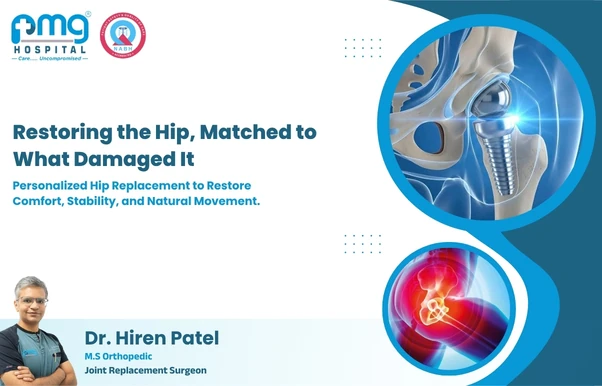
An artificial hip copies the natural joint, a rounded head turning inside a cup-shaped hollow, using a few parts that fit together:
| Part | Where it goes | Usually made of |
|---|---|---|
| Stem | Inside the upper part of the thigh bone (femur) | Metal alloy |
| Head (ball) | On top of the stem | Ceramic or metal |
| Cup | In the socket of the pelvis | A metal shell holding a liner (uncemented), or polyethylene alone (cemented) |
| Liner | Inside a metal-shell cup, where the head moves | Polyethylene (medical-grade plastic) or ceramic |
The parts are fixed either with bone cement or by a tight press-fit, in which the bone grows onto a textured implant surface. In a partial hip replacement, only the stem and head are used, and the person’s own socket is kept.
Types
Three Types of Hip Replacement
| Operation | Usually used for | What is replaced | Usual stay |
|---|---|---|---|
| Total hip replacement | Arthritis or avascular necrosis affecting both the ball and the socket | The ball and the socket | 2–4 days |
| Partial hip replacement (hemiarthroplasty) | Mostly a displaced fracture of the neck of the femur in an older person | Only the ball | About 2–5 days |
| Revision hip replacement | An earlier hip implant that has loosened, worn, dislocated repeatedly or become infected | The failed parts, with lost bone rebuilt | 5–10 days |
Total Hip Replacement
Both the ball and the socket are replaced. This is the usual operation when arthritis or avascular necrosis has damaged the whole joint.
Partial Hip Replacement (Hemiarthroplasty)
Only the femoral head is replaced, most often when an elderly patient has broken the hip and the acetabulum is still healthy. The main aim is to get the person standing and walking again soon after the injury.
Revision Hip Replacement (Redo Surgery)
An earlier hip replacement that has loosened, worn, kept dislocating or become infected is taken out and replaced, and any lost bone is rebuilt.
Causes
Conditions That Damage the Hip
| Condition | What happens to the hip |
|---|---|
| Osteoarthritis | The cartilage of the ball and socket wears away until the bones rub; the most common reason for hip replacement |
| Avascular necrosis | Bone in the femoral head dies after losing its circulation and then collapses; it often affects adults in their thirties and forties and is linked with steroid medicines, heavy alcohol use, sickle-cell disease and earlier hip injury |
| Fracture of the neck of the femur | The bone breaks just below the head, usually in a fall; if the broken ends shift, the head often loses its circulation |
| Rheumatoid arthritis | Inflammation of the joint lining damages the hip, often on both sides and at a younger age |
| Childhood hip problems | Developmental dysplasia, Perthes disease or a slipped upper femoral epiphysis can leave a hip shape that wears out early in adult life |
| Ankylosing spondylitis | Inflammation can make the hips very stiff and, in some people, fuse them |
Symptoms
Symptoms That Should Be Checked
- Deep pain in the groin or front of the thigh when walking or standing
- Struggling to wear socks and shoes or to trim your toenails
- A limp that has started or is getting worse
- Pain at night, especially when turning over
- Stiffness that makes getting into a car or an autorickshaw difficult
- Hip or groin pain in a young adult who has taken steroids, drinks heavily or has sickle-cell disease
None of these means that an operation is needed. They are reasons to have the hip examined and X-rayed. In a young adult with unexplained groin pain, an MRI scan can show avascular necrosis before the ball collapses.
Before surgery
Before Surgery: What Can Help
| Approach | How it helps |
|---|---|
| Weight reduction | Reduces the load that passes through the hip |
| A walking stick | Held in the hand opposite the painful hip, it takes some weight off the joint |
| Exercises for the muscles at the side of the hip | Stronger abductor muscles support the joint and can ease a limp |
| Pain medicines | Help during painful phases; long-term daily use of anti-inflammatory tablets needs medical advice |
These measures can control symptoms in earlier disease, but they do not rebuild worn cartilage or a collapsed ball. In early avascular necrosis, before the ball has collapsed, joint-preserving treatment may be possible, which is why early imaging matters. Once the ball has collapsed, that option usually no longer applies.
Planning
Hip Replacement Operation in Ahmedabad: Step by Step
If your hip replacement operation in Ahmedabad is planned, these are the usual steps at PMG Hospital:
- 1Implant size, leg length and hip position are worked out in advance on X-rays.
- 2Blood tests, an anaesthesia assessment and other checks confirm fitness for surgery.
- 3The surgeon opens the hip from the back, the side or the front.
- 4The worn femoral head is taken off; in a total replacement, the acetabulum is reamed into shape to hold the cup.
- 5The stem is placed inside the thigh bone and the new ball is fixed on it.
- 6Before closing, the surgeon tests how stable the new joint is and compares the leg lengths.
Cemented or Uncemented Fixation?
| Patient | Fixation often used | Reason |
|---|---|---|
| Younger and active, with good bone | Uncemented (press-fit) | The bone grows onto the implant for long-term fixation |
| Older, with softer bone | Cemented, or cemented on one side only (hybrid) | Cement gives firm fixation straight away |
The surgeon decides for each patient after looking at age, the strength of the bone and how active the person is.
Recovery
Recovery and Getting Back to Routine
| Stage | What usually happens |
|---|---|
| Day of surgery or next morning | First time on your feet, using a walker under a physiotherapist’s guidance |
| Days 2–4 | Home for most people after a total hip replacement |
| Weeks 3–6 | Many people walk without support |
| Around week 6 | Driving again for most people, if the surgeon agrees |
| Up to about 6 months | Time often needed for full recovery when the hip was badly damaged |
Preparing Your Home
- A raised toilet seat or commode
- A firm chair with arms, so that you do not sink into a low seat
- Clear walkways without loose rugs
- Everyday items kept at waist height
For the first weeks, avoid bending the hip deeply, crossing the legs and twisting on a planted foot. The physiotherapist shows you how to sit, stand and get into a vehicle safely.
Risks
Risks to Discuss Before Surgery
- Infection around the implant
- A blood clot in a leg vein, which can occasionally travel to the lungs
- The new hip slipping out of joint (dislocation), a risk that is highest early on
- A difference in leg length
- A crack or break in the thigh bone during or after the operation
- Injury to a nerve near the hip (uncommon)
- After many years, the implant may wear or work loose and need to be redone
Diabetes, smoking and infections elsewhere in the body increase the risk of infection, so they are treated or controlled before surgery wherever possible.
Cost
Hip Replacement Surgery Cost in Ahmedabad
The cost of hip replacement surgery in Ahmedabad depends mainly on:
- The type of operation: total, partial or revision
- The bearing materials, such as ceramic or polyethylene
- Cemented or uncemented fixation
- The room category and the number of days in hospital
- Pre-operative tests, the physiotherapy course and check-up visits
A partial hip replacement usually costs less than a total, and a revision usually costs more. PMG Hospital gives a written, itemised estimate once the hip has been assessed. Check your insurance cover with your insurer.
Choosing
How to Choose a Hip Replacement Doctor in Ahmedabad
Whichever hip replacement doctor in Ahmedabad you consult, it is reasonable to check:
- The surgeon’s medical council registration number
- Qualifications in orthopaedics and training in joint replacement
- Whether the choice of implant and fixation is explained for your age and activity
- A clear account of the risks, including dislocation and leg length
- The physiotherapy plan after surgery
The care team
Hip Replacement Surgery Doctor in Ahmedabad
Looking for a hip replacement surgery doctor in Ahmedabad generally means looking for an orthopaedic surgeon whose training includes joint replacement (arthroplasty), because that surgeon assesses the hip, selects the implant and carries out the operation. Even so, a hip replacement is teamwork, and the people involved vary with the situation, for example a planned operation for arthritis or an urgent one after a fall:
| Team member | Part they play in hip replacement |
|---|---|
| Orthopaedic surgeon | Assesses the hip, works out implant size and leg length on the X-rays, performs the replacement and follows the healing afterwards |
| Anaesthetist | Confirms fitness for anaesthesia and gives a spinal or a general anaesthetic; a nerve block around the hip may be added for pain relief |
| Physician or cardiologist | Looks after the heart, lungs, blood sugar and blood pressure; for an older person with a broken hip, helps make them ready for surgery without undue delay |
| Radiologist | Reports the X-rays, an MRI when avascular necrosis is suspected, or a CT scan when bone loss must be judged before a revision |
| Microbiologist or infectious-disease doctor | Guides the tests and the choice of antibiotics when an earlier implant may be infected |
| Physiotherapist | Helps you stand and walk, and teaches safe ways to sit, bend and climb stairs while the hip heals |
For an older family member with a hip fracture, carrying a list of every current medicine, along with any recent heart or kidney reports, makes the fitness checks before surgery quicker.
Surgeon
Who Performs the Operation
At PMG Hospital, Gota, hip replacement is performed by:
| Field | Detail |
|---|---|
| Surgeon | Dr. Hiren Patel |
| Qualifications | MBBS, MS (Ortho), International Fellowship in Joint Replacement |
| Medical college | B.J. Medical College, Ahmedabad (MBBS and MS (Ortho)) |
| Role at PMG Hospital | Director & Head Joint Replacement Surgeon |
| Registration | Registered Medical Practitioner; Gujarat Medical Council Reg. No. G-20583 |
| OPD | Monday to Saturday, 10:00 AM to 8:00 PM; Sunday by appointment |
Hospital
Where the Operation Takes Place
Hip replacement is carried out at PMG Hospital, Gota, Ahmedabad. Services relevant to hip replacement include:
- Orthopaedic OPD: Monday to Saturday, 10:00 AM to 8:00 PM; Sunday by appointment
- Emergency and trauma care, available 24×7
- Physiotherapy at the hospital
FAQs
Common Questions
Hip replacement pages: Total hip replacement·Partial hip replacement (hemiarthroplasty)·Revision hip replacement
Contact
Reaching PMG Hospital
Address
PMG Hospital (PMG Orthopedic Hospital)
3rd Floor, Athena Avenue, B/H Jaguar Showroom, Krishna Hardware Road, Nr. Eulogia Inn Hotel, S.G. Highway, Gota, Ahmedabad, Gujarat 382481
- Phone
- +91 96625 91666
- Phone and WhatsApp
- +91 96627 70141
- OPD
- Monday to Saturday, 10:00 AM to 8:00 PM; Sunday by appointment
- Emergency and trauma care
- 24×7
Get in touch
Call or send your reports, or open the hospital’s location in Google Maps.
Medically reviewed by Dr. Hiren Patel, MS (Ortho.), Joint Replacement Surgeon, PMG Hospital, Ahmedabad.