

Partial Hip Replacement (Hemiarthroplasty) Surgery in Ahmedabad, Gujarat
Restoring Only the Ball, After a Fractured Hip
A partial hip replacement, also called a hemiarthroplasty, is most often used when an older person has broken the hip just below the ball (a displaced fracture of the neck of the femur) and the socket is still healthy. Only the broken femoral head is replaced, with an artificial head on a metal stem, while the person’s own socket is kept. This makes the operation shorter, with less blood loss, than a total hip replacement. The main aim is to get the person out of bed and walking soon after surgery, often within a day, because long periods in bed bring serious risks for older people. At PMG Hospital in Gota, Ahmedabad, the usual hospital stay is about two to five days.
Why the ball
Why Only the Ball Is Replaced
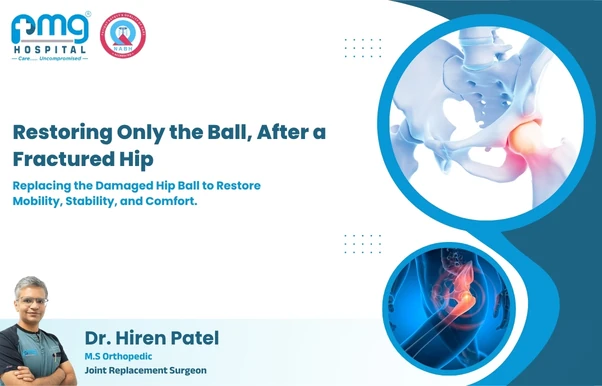
When the neck of the femur breaks and the two ends move apart, the blood vessels that feed the femoral head are often torn. Without a blood supply, the head may not heal even if the fracture is fixed, and it can later collapse. Replacing the head avoids that problem.
In many older people, the socket itself is not worn. Leaving it in place keeps the operation smaller, which matters for patients who also have heart, lung or other medical conditions.
Options
Partial or Total After a Hip Fracture?
Not every broken hip is treated the same way. The decision rests on how the bone has broken, the patient’s age, how well they were walking before the fall, and their overall health.
| Option | Usually chosen when | Points to weigh |
|---|---|---|
| Fixing the fracture with screws | Younger person, or a fracture that has not moved out of place, with the blood supply likely intact | Keeps the natural head, but further surgery may be needed if the fracture does not heal or the head loses its blood supply |
| Partial hip replacement (hemiarthroplasty) | Older person with a displaced fracture and a healthy socket | Shorter operation with less blood loss; the natural socket can wear over the years |
| Total hip replacement | An independent person who was walking outdoors before the fall and is fit for the larger operation, or anyone who already has arthritis in the socket | Replaces both surfaces; a larger operation with a higher risk of dislocation |
The UK’s NICE guideline on hip fracture advises considering a total hip replacement, rather than a partial one, for people with a displaced fracture of the neck of the femur when three things apply: before the fall they walked outdoors on their own, using a stick at most; no illness or memory problem makes the operation unsuitable for them; and they are expected to look after themselves in daily life for the long term.
Who it suits
Who Is Usually Suited to a Partial Hip Replacement?
- An older person with a displaced fracture of the neck of the femur
- A socket that shows no arthritis on X-ray
- Limited walking before the fall, or significant medical conditions
- A situation in which a shorter operation with less blood loss is the safer option
A younger, active person, or someone who already has arthritis in the socket, is usually better suited to a total hip replacement.
Timing
Why Surgery Is Done Promptly
NICE advises operating on a hip fracture either on the day the patient is admitted or on the following day. Before the operation, the heart, lungs, blood tests and medicines (such as blood thinners) are checked and, where possible, corrected, so that the patient is as fit as possible for anaesthesia. After surgery, getting out of bed early helps to prevent the problems that come from lying still.
The operation
Partial Hip Replacement Operation in Ahmedabad: Step by Step
When a partial hip replacement operation in Ahmedabad is planned at PMG Hospital, the main steps are:
- 1Medical checks and treatment to make the patient as fit as possible for anaesthesia.
- 2Removal of the broken femoral head.
- 3Fitting of a stem in the thigh bone with a new head, either a one-piece head (unipolar) or a two-part head with an inner bearing (bipolar), fixed with or without bone cement.
- 4Testing the new hip for stability in different positions before the wound is closed.
Expectations
What a Partial Hip Replacement Can and Cannot Do
| It can | It cannot |
|---|---|
| Allow standing and walking soon after a hip fracture | Promise a return to the level of walking before the fall |
| Avoid the long bed rest that leads to chest infection, clots and bedsores | Stop the natural socket from wearing in a long-lived, active person |
| Be done as a shorter operation, with less blood loss, than a total replacement | Remove the risks of surgery for a frail patient |
| Carry a lower early risk of dislocation than a total replacement | Treat a socket that is already arthritic; a total replacement is then needed |
Recovery
Recovery Timeline After a Partial Hip Replacement
| When | What usually happens |
|---|---|
| Days 0–1 | Getting the patient up is a priority; standing and assisted walking often begin within a day of surgery |
| Days 2–5 | Discharge home for most patients, walking with a frame; breathing exercises and clot prevention continue |
| Weeks 2–6 | Walking distance increases step by step |
| Months 2–3 | Many patients regain much of their earlier mobility; some continue to need a stick or frame |
Care at Home After Discharge
- A family member or carer to help during the first weeks
- A walking frame, and a home free of loose rugs and trailing wires
- Good lighting at night, especially on the way to the toilet
- A check of bone strength (osteoporosis) and of the risk of further falls
Risks
Risks to Discuss Before Surgery
- Infection in the wound or around the implant
- Blood clots in the legs or lungs
- Chest infection
- Delirium (a short-lived state of confusion), seen fairly often in elderly patients after an operation
- Dislocation of the hip
- A break in the thigh bone around the implant
- Heart, lung or kidney complications, which can be serious in frail patients
- Wear of the natural socket over the years, causing groin pain
Heart and lung conditions increase the risks of anaesthesia and surgery, which is why they are assessed and treated as far as possible beforehand.
Cost
Partial Hip Replacement Surgery Cost in Ahmedabad
The cost of partial hip replacement surgery in Ahmedabad depends mainly on:
- The type of implant, and whether it is cemented or uncemented
- The room category and the number of days in hospital
- Treatment needed for other medical conditions before and after surgery
- Physiotherapy and follow-up visits
A partial hip replacement usually costs less than a total. PMG Hospital provides a written, itemised estimate after the assessment. Check your insurance cover with your insurer.
Questions
Questions to Ask a Partial Hip Replacement Doctor in Ahmedabad
Whichever partial hip replacement doctor in Ahmedabad the family meets, these questions are useful:
- Should the fracture be fixed, or should the hip be replaced?
- Would a total hip replacement be more suitable for this patient?
- Which medical conditions need attention before the operation?
- How soon after surgery will the patient be helped to stand?
- What support will be needed at home after discharge?
The care team
Partial Hip Replacement Surgery Doctor in Ahmedabad
After a hip fracture, any partial hip replacement surgery doctor in Ahmedabad should, first of all, be an orthopaedic surgeon with training in both fracture care and joint replacement (arthroplasty). Because most patients are elderly and many have other illnesses, the medical and anaesthetic side of care carries as much weight as the operation itself:
| Team member | Part they play after a broken hip |
|---|---|
| Emergency doctor | Gives early pain relief after the fall and arranges the first X-rays |
| Orthopaedic surgeon | Judges whether the fracture should be fixed or the head replaced, chooses the implant and performs the operation |
| Physician, geriatrician or cardiologist | Corrects heart, lung, kidney and blood sugar problems before surgery, adjusts blood thinners, watches for confusion afterwards and looks at bone strength |
| Anaesthetist | Weighs the anaesthetic risk, often starts a nerve block early for pain, and gives a spinal or a general anaesthetic for the operation |
| Radiologist | Reports the X-rays of the hip and pelvis; if a break is suspected but cannot be seen clearly, an MRI or CT scan may follow |
| Physiotherapist | Helps the patient stand within a day where possible, teaches walking with a frame and advises on preventing further falls |
Relatives can help by telling the team how the patient was walking before the fall, whether there are any memory problems, and which medicines are taken each day, as these details shape both the choice of operation and the anaesthetic plan.
Surgeon
Who Performs the Operation
At PMG Hospital, Gota, partial hip replacement (hemiarthroplasty) is performed by:
| Field | Detail |
|---|---|
| Surgeon | Dr. Hiren Patel |
| Qualifications | MBBS, MS (Ortho), International Fellowship in Joint Replacement |
| Medical college | B.J. Medical College, Ahmedabad (MBBS and MS (Ortho)) |
| Role at PMG Hospital | Director & Head Joint Replacement Surgeon |
| Registration | Registered Medical Practitioner; Gujarat Medical Council Reg. No. G-20583 |
| OPD | Monday to Saturday, 10:00 AM to 8:00 PM; Sunday by appointment |
Hospital
Where the Operation Takes Place
Partial hip replacement is carried out at PMG Hospital, Gota, Ahmedabad. Services relevant to partial hip replacement include:
- Orthopaedic OPD: Monday to Saturday, 10:00 AM to 8:00 PM; Sunday by appointment
- Emergency and trauma care, available 24×7
- Physiotherapy at the hospital
FAQs
Common Questions
Related hip pages: Total hip replacement·Revision hip replacement·Hip replacement overview
Contact
Reaching PMG Hospital
Address
PMG Hospital (PMG Orthopedic Hospital)
3rd Floor, Athena Avenue, B/H Jaguar Showroom, Krishna Hardware Road, Nr. Eulogia Inn Hotel, S.G. Highway, Gota, Ahmedabad, Gujarat 382481
- Phone
- +91 96625 91666
- Phone and WhatsApp
- +91 96627 70141
- OPD
- Monday to Saturday, 10:00 AM to 8:00 PM; Sunday by appointment
- Emergency and trauma care
- 24×7
Get in touch
Call or send your reports, or open the hospital’s location in Google Maps.
Medically reviewed by Dr. Hiren Patel, MS (Ortho.), Joint Replacement Surgeon, PMG Hospital, Ahmedabad.