
Total Hip Replacement Surgery in Ahmedabad, Gujarat
Restoring Both the Ball and the Socket of the Hip
A total hip replacement is usually advised when arthritis or avascular necrosis has damaged both the ball and the socket of the hip, and pain, stiffness or a limp keep limiting walking, sleep and daily tasks despite medicines and physiotherapy. Both worn surfaces are replaced: a metal stem with a ceramic or metal ball goes into the thigh bone, and a new cup, with a smooth bearing surface, is fitted into the pelvis. At PMG Hospital in Gota, Ahmedabad, the usual hospital stay is two to four days. Most people walk without support within three to six weeks, start driving at around six weeks and are close to full recovery by about three months.
The operation
What a Total Hip Replacement Involves
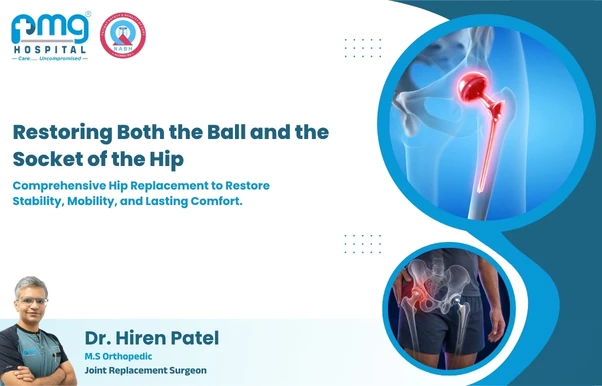
Both halves of the joint are replaced. A stem fixed inside the femur carries a new head, and a cup fixed in the pelvis holds a liner in which that head moves. Together they take over the job that the cartilage used to do.
The surfaces that rub against each other are called the bearing. Common combinations include:
| Bearing (head on liner) | Points to know |
|---|---|
| Ceramic on polyethylene | Widely used, including in younger and active people |
| Metal on polyethylene | Often used in older people |
| Ceramic on ceramic | Very hard-wearing; sometimes chosen for younger patients |
The bearing is chosen for each person, based on age and activity.
Causes
Why Some Hips Wear Out Early
Osteoarthritis is the most common reason for a total hip replacement, but many people need one well before old age. Avascular necrosis, in which part of the femoral head loses its blood supply and collapses, often affects adults in their thirties and forties. It is linked with steroid medicines, heavy alcohol use, sickle-cell disease and injury to the hip. Rheumatoid arthritis, hip problems that began in childhood and old fractures around the hip account for many other cases.
This matters for planning. A young person with avascular necrosis needs an implant and bearing chosen for many years of use, while an older person with arthritis may be better suited to cemented fixation that is firm straight away.
Who it suits
Is a Total Hip Replacement Likely to Suit You?
It is usually considered for:
- Severe osteoarthritis of the hip, or hip damage from rheumatoid arthritis
- Avascular necrosis in which the femoral head has collapsed
- Arthritis after a fracture of the hip or the socket
- Ankylosing spondylitis with a stiff or fused hip
- A damaged socket after an earlier fracture fixation has failed
An examination and X-rays, with an MRI scan when early avascular necrosis is suspected, show whether replacement is needed or whether the hip can still be managed without it.
The operation
Total Hip Replacement Operation in Ahmedabad: Step by Step
If your total hip replacement operation in Ahmedabad is planned, these are the main steps at PMG Hospital:
- 1Planning on X-rays: the sizes of the stem and cup, the hip’s offset and the leg length are worked out in advance.
- 2The hip is approached from the back, the side or the front, with care taken to protect the surrounding muscles and tissues.
- 3The worn femoral head is removed, the socket is reamed to shape, and the cup is fixed either by a tight press-fit or with cement.
- 4The femoral stem goes into the hollow of the femur and carries the new head; the surgeon then tests stability and compares leg lengths before closing.
Matching the Implant to the Patient
| Patient | Fixation | Bearing often used | Reason |
|---|---|---|---|
| Younger and active, for example with avascular necrosis in the thirties or forties | Uncemented (press-fit) | Ceramic on polyethylene, or ceramic on ceramic | Chosen to last many years |
| Older, with softer bone | Cemented, or hybrid (one part cemented) | Ceramic or metal on polyethylene | Firm fixation from the start |
Expectations
What a Total Hip Replacement Can and Cannot Do
| It can | It cannot |
|---|---|
| Usually relieve deep groin and buttock pain caused by a worn joint | Promise that every bit of pain will go |
| Usually improve the movement needed for socks, shoes and sitting comfortably | Make deep squatting or sitting on the floor safe for everyone |
| Improve or correct a limp caused by a collapsed hip | Promise exactly equal leg lengths in every case |
| Allow a return to walking, driving and work with physiotherapy | Last forever; implants can wear or loosen over the years |
Recovery
Recovery Timeline After a Total Hip Replacement
| When | What usually happens |
|---|---|
| Days 0–1 | Standing and walking with support, often on the day of surgery; hip precautions are explained before you get up |
| Days 2–4 | Discharge for most people, walking with a walker or stick and managing stairs under supervision |
| Weeks 2–6 | Stitches removed at about 2 weeks; walking distance increases, and many stop using a walking aid indoors |
| Weeks 6–12 | Driving, routine work and normal household activity for most people |
| Months 3–12 | Strength and confidence keep improving |
Hip Precautions in the First Weeks
- Do not bend the hip sharply, for example to pick things up from the floor
- Do not cross your legs
- Do not twist on the operated leg while your foot is planted
- Avoid low chairs, low toilet seats and sitting on the floor
These precautions are relaxed on the surgeon’s advice, depending on how the hip is healing.
Risks
Risks and Implant Lifespan
- Infection, either in the skin wound or deep at the implant
- A blood clot in a leg vein, which can occasionally reach the lungs
- The hip coming out of joint (dislocation), a risk that is greatest early on
- A difference in leg length
- A break in the thigh bone during or after the operation
- Injury to the sciatic nerve or other nearby nerves (uncommon)
Diabetes, smoking and untreated infections raise the risk of infection, so these are dealt with before surgery wherever possible. An implant is a mechanical device and can wear with time; published long-term data, summarised in the questions below, show that about 9 out of 10 hip replacements were still working 15 years after surgery.
Cost
Total Hip Replacement Surgery Cost in Ahmedabad
The cost of total hip replacement surgery in Ahmedabad depends mainly on:
- The bearing materials, for example ceramic or polyethylene
- Cemented, uncemented or hybrid fixation
- The room category and number of days in hospital
- Pre-operative investigations, the physiotherapy course and check-up visits
PMG Hospital provides a written, itemised estimate once the hip has been assessed. Ask which items are included, and check your insurance cover with your insurer.
Questions
Questions to Ask a Total Hip Replacement Doctor in Ahmedabad
Whichever total hip replacement doctor in Ahmedabad you consult, these questions help you make an informed decision:
- Is a total hip replacement needed now, or can treatment without surgery continue for a while?
- Which bearing and fixation are planned for me, and why?
- Which approach (back, side or front) is planned for my hip?
- How will leg length be planned and checked?
- Which movements must I avoid, and for how long?
- What physiotherapy will I need after discharge?
The care team
Total Hip Replacement Surgery Doctor in Ahmedabad
Any total hip replacement surgery doctor in Ahmedabad who takes charge of your care should be an orthopaedic surgeon with training in joint replacement (arthroplasty). That surgeon decides whether both the ball and the socket need replacing and performs the operation, but several colleagues contribute at each stage:
| Stage | Who is involved | What they do |
|---|---|---|
| Diagnosis and planning | Orthopaedic surgeon | Examines the hip, measures it on X-rays, and selects the bearing, fixation and surgical approach |
| Imaging | Radiologist | Interprets the hip X-rays, plus an MRI scan if early avascular necrosis is suspected |
| Fitness for surgery | Physician or cardiologist | Brings diabetes, blood pressure and heart conditions under control, and advises which medicines to pause, such as blood thinners |
| Operation day | Anaesthetist | Gives a spinal or a general anaesthetic and plans pain control for the first days, sometimes with a nerve block |
| On the ward and at home | Physiotherapist | Teaches the hip precautions, starts walking with a walker and builds strength until a walking aid is no longer needed |
Younger adults with avascular necrosis may also be asked about steroid use, alcohol intake or sickle-cell disease, so that any linked condition can be looked after alongside the operation.
Surgeon
Who Performs the Operation
At PMG Hospital, Gota, total hip replacement is performed by:
| Field | Detail |
|---|---|
| Surgeon | Dr. Hiren Patel |
| Qualifications | MBBS, MS (Ortho), International Fellowship in Joint Replacement |
| Medical college | B.J. Medical College, Ahmedabad (MBBS and MS (Ortho)) |
| Role at PMG Hospital | Director & Head Joint Replacement Surgeon |
| Registration | Registered Medical Practitioner; Gujarat Medical Council Reg. No. G-20583 |
| OPD | Monday to Saturday, 10:00 AM to 8:00 PM; Sunday by appointment |
Hospital
Where the Operation Takes Place
Total hip replacement is carried out at PMG Hospital, Gota, Ahmedabad. Services relevant to total hip replacement include:
- Orthopaedic OPD: Monday to Saturday, 10:00 AM to 8:00 PM; Sunday by appointment
- Emergency and trauma care, available 24×7
- Physiotherapy at the hospital
FAQs
Common Questions
Related hip pages: Partial hip replacement (hemiarthroplasty)·Revision hip replacement·Hip replacement overview
Contact
Reaching PMG Hospital
Address
PMG Hospital (PMG Orthopedic Hospital)
3rd Floor, Athena Avenue, B/H Jaguar Showroom, Krishna Hardware Road, Nr. Eulogia Inn Hotel, S.G. Highway, Gota, Ahmedabad, Gujarat 382481
- Phone
- +91 96625 91666
- Phone and WhatsApp
- +91 96627 70141
- OPD
- Monday to Saturday, 10:00 AM to 8:00 PM; Sunday by appointment
- Emergency and trauma care
- 24×7
Get in touch
Call or send your reports, or open the hospital’s location in Google Maps.
Medically reviewed by Dr. Hiren Patel, MS (Ortho.), Joint Replacement Surgeon, PMG Hospital, Ahmedabad.