
Partial (Unicondylar) Knee Replacement Surgery in Ahmedabad, Gujarat
Renewing Only the Worn Compartment, Keeping the Rest of Your Knee
A partial knee replacement can be an option when arthritis has worn out only one side of your knee, most often the inner side, while the rest of the joint and its ligaments are still healthy. Only the damaged part is resurfaced with a small implant; both cruciate ligaments stay, and less bone is removed than in a total knee replacement. Not every knee qualifies; standing X-rays and a careful examination show whether yours does. At PMG Hospital in Gota, Ahmedabad, the usual hospital stay is about one to two days, and many people are back to routine household activity within three to four weeks.
What it is
One Worn Side, Not the Whole Knee
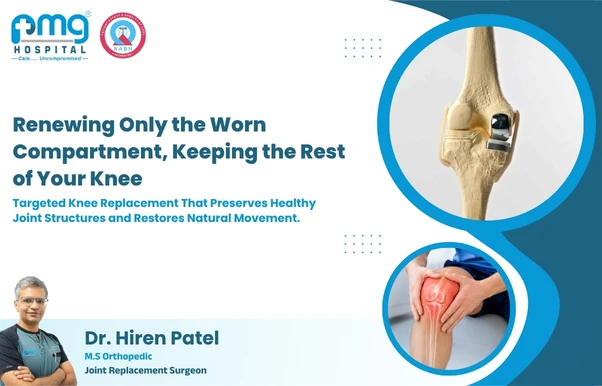
Osteoarthritis often starts on the inner side of the knee, where the body’s weight is concentrated when the leg is slightly bowed. If the outer side and the kneecap joint are still healthy, replacing all three compartments would remove more than the problem requires. A partial replacement resurfaces only the damaged side.
Because less bone is removed and the ligaments stay in place, many people find that a partial knee feels closer to a natural knee than a total replacement does. The incision is shorter, blood loss is usually lower, and the hospital stay is often shorter.
Selection
Selection Comes First
A partial knee replacement works well only in a knee that truly meets its requirements, and these are checked before surgery is offered:
| Requirement | How it is checked | Why it matters |
|---|---|---|
| Arthritis limited to one compartment | Standing X-rays, stress X-rays and an MRI scan if there is doubt | Wear elsewhere tends to cause pain again and lead to further surgery |
| Intact anterior cruciate ligament (ACL) | Clinical examination, with imaging where needed | The partial implant relies on the knee’s own ligaments for stability |
| Deformity that corrects with gentle pressure | Examination and stress X-rays | A fixed deformity cannot be corrected by a one-sided implant |
| No inflammatory arthritis | Medical history and blood tests where needed | Conditions such as rheumatoid arthritis affect the whole joint lining |
Comparison
Partial and Total Compared
| Feature | Partial (unicondylar) | Total knee replacement |
|---|---|---|
| Suitable knee | One-sided wear with a healthy ACL | Widespread wear, or a marked deformity |
| Where bone is trimmed | The affected side alone | The thigh-bone and shin-bone surfaces, and the kneecap if needed |
| Cruciate ligaments | Both kept | The ACL is usually removed; the PCL is kept or its role is taken over by the implant |
| Length of incision | Shorter | Longer |
| Usual hospital stay | About 1–2 days | 2–4 days |
| Usual return to routine household activity | 3–4 weeks | 6–8 weeks |
| If arthritis spreads later | Can be converted to a total | Revision if the implant wears or loosens |
The operation
Partial Knee Replacement Operation in Ahmedabad: Step by Step
At PMG Hospital, the operation has four main stages:
- 1Suitability is confirmed one last time: the X-rays and examination must show sound cartilage elsewhere in the knee and a working ACL.
- 2A short incision gives access to the worn side of the joint.
- 3Only the damaged surfaces of that compartment are removed; the ligaments and healthy cartilage are left alone.
- 4The single-compartment implant is fitted with as little bone removal as possible, and its position and movement are checked before closing.
Trade-offs
Advantages and Trade-Offs
| Possible advantages | Trade-offs to accept |
|---|---|
| Both cruciate ligaments are kept, which helps the knee keep more of its natural feel and position sense | The untouched compartments can still develop arthritis later |
| Less bone is removed, and blood loss is usually lower than with a total | Further surgery is needed more often than after a total |
| A shorter stay and often an earlier end to walking aids | Strict selection means many knees are not suitable |
| A total knee replacement remains possible later | Running and jumping are not advised |
Recovery
Recovery Milestones
| When | What usually happens |
|---|---|
| Days 0–1 | Standing and assisted walking, often on the day of surgery; with the ligaments intact, control of the knee tends to return quickly |
| Days 1–2 | Discharge for most people |
| Weeks 1–3 | Walking aids are usually put aside indoors |
| Weeks 3–8 | Routine household activity from about 3–4 weeks; work and driving for most people by about 4–8 weeks |
| From month 3 | Strength and confidence keep improving; low-impact exercise is encouraged |
Risks
Risks Specific to a Partial Knee
The main long-term concern after a partial replacement is arthritis progressing in the parts of the knee that were left alone. This is the natural course of the disease rather than a fault of the operation, but it is the most frequent reason for further surgery. In that situation, a total knee implant can usually take the place of the partial one.
The general risks of knee replacement also apply: infection, blood clots in the leg veins, stiffness, and, rarely, injury to a nerve or blood vessel. Because the operation is smaller, these general risks are often lower than with a total replacement.
Cost
Partial Knee Replacement Surgery Cost in Ahmedabad
- The type of implant
- The room category and number of days in hospital
- Investigations before the operation
- Physiotherapy and follow-up visits
Because the operation is smaller and the stay shorter, the overall cost is often lower than for a total. PMG Hospital provides a written, itemised estimate before admission, after the X-rays and scans have been studied. Check insurance cover with your insurer.
Questions
Questions to Ask a Partial Knee Replacement Doctor in Ahmedabad
Whichever surgeon you see, these questions help to check whether the operation fits your knee:
- Which compartment is worn, and are the others healthy on X-ray?
- Is my ACL intact?
- Would a total replacement or non-surgical treatment be more suitable?
- What would happen if arthritis spread to another compartment later?
- How long is physiotherapy likely to last?
The care team
Partial Knee Replacement Surgery Doctor in Ahmedabad
Anyone looking for a partial knee replacement surgery doctor in Ahmedabad needs, first of all, an orthopaedic surgeon with arthroplasty (joint replacement) training, since everything hinges on whether the knee meets the strict selection rules described above. Once the operation is agreed, a small team shares the remaining work.
| Stage | Who is involved | What they do |
|---|---|---|
| Checking suitability | Orthopaedic surgeon | Tests the ACL, sees whether any bow corrects with gentle pressure, and studies standing and stress X-rays before agreeing that a one-sided implant fits |
| Imaging | Radiologist | Reports the X-rays and, when the state of the other compartments is uncertain, an MRI scan |
| Medical fitness | Physician | Looks at sugar, blood pressure and other long-term conditions, and advises which tablets to pause or continue |
| Anaesthesia | Anaesthetist | Gives spinal or general anaesthesia, and may add a nerve block to keep the knee comfortable after surgery |
| Operation | Orthopaedic surgeon with the theatre team | Resurfaces only the worn compartment, leaving the ligaments and healthy cartilage in place |
| Rehabilitation | Physiotherapist | Starts assisted walking, often on the day of surgery, and builds thigh strength over the following weeks |
With a hospital stay of only a day or two, most of the exercise programme carries on at home, so it helps to know before admission who will oversee physiotherapy after discharge.
Surgeon
Who Performs the Operation
At PMG Hospital, Gota, partial (unicondylar) knee replacement is performed by:
| Field | Detail |
|---|---|
| Surgeon | Dr. Hiren Patel |
| Qualifications | MBBS, MS (Ortho), International Fellowship in Joint Replacement |
| Medical college | B.J. Medical College, Ahmedabad (MBBS and MS (Ortho)) |
| Role at PMG Hospital | Director & Head Joint Replacement Surgeon |
| Registration | Registered Medical Practitioner; Gujarat Medical Council Reg. No. G-20583 |
| OPD | Monday to Saturday, 10:00 AM to 8:00 PM; Sunday by appointment |
Hospital
Where the Operation Takes Place
Knee replacement is carried out at PMG Hospital, Gota, Ahmedabad. Services relevant to knee replacement include:
- Orthopaedic OPD: Monday to Saturday, 10:00 AM to 8:00 PM; Sunday by appointment
- Emergency and trauma care, available 24×7
- Physiotherapy at the hospital
FAQs
Common Questions
See also: Total knee replacement·Revision knee replacement·Knee replacement overview
Contact
Reaching PMG Hospital
Address
PMG Hospital (PMG Orthopedic Hospital)
3rd Floor, Athena Avenue, B/H Jaguar Showroom, Krishna Hardware Road, Nr. Eulogia Inn Hotel, S.G. Highway, Gota, Ahmedabad, Gujarat 382481
- Phone
- +91 96625 91666
- Phone and WhatsApp
- +91 96627 70141
- OPD
- Monday to Saturday, 10:00 AM to 8:00 PM; Sunday by appointment
- Emergency and trauma care
- 24×7
Get in touch
Call or send your reports, or open the hospital’s location in Google Maps.
Medically reviewed by Dr. Hiren Patel, MS (Ortho.), Joint Replacement Surgeon, PMG Hospital, Ahmedabad.