
Revision & Reverse Shoulder Replacement in Ahmedabad, Gujarat
Reversing the Shoulder’s Mechanics, or Rebuilding a Failed Implant
A reverse shoulder replacement is used when the rotator cuff has failed beyond repair, most often together with arthritis (cuff tear arthropathy), and the arm can no longer be lifted properly. It is also commonly used to revise an earlier shoulder replacement that has failed. In this design, the ball and socket swap places, which lets the large deltoid muscle lift the arm instead of the damaged cuff. At PMG Hospital in Gota, Ahmedabad, the usual hospital stay is about three to five days. The arm rests in a sling for about four weeks, and useful overhead function usually returns between three and six months.
How it works
How a Reverse Shoulder Replacement Works
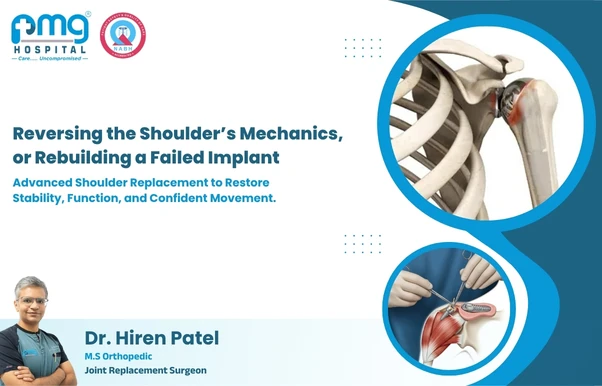
In a natural joint, the rounded head sits at the top of the humerus, and the socket (glenoid) lies on the scapula, the shoulder blade. A reverse replacement turns this around: a metal ball (glenosphere) is fixed to the shoulder blade, and a cup is fitted to the top of the arm bone. This change moves the centre of rotation and lengthens the lever of the deltoid muscle, so that it can raise the arm without help from the rotator cuff.
When the rotator cuff is intact, an anatomic (standard) replacement is usually the better choice, and a reverse design is not needed.
Who it suits
When a Reverse Design Is Used
- Cuff tear arthropathy, with an arm that cannot be lifted actively
- A failed or loose earlier shoulder replacement
- An old fracture in which the tuberosities (where the cuff tendons attach) have not healed
- Repeated instability after earlier shoulder surgery
- Certain complex upper-arm fractures in older patients
An X-ray, a CT scan of the shoulder blade and an assessment of the rotator cuff show whether a reverse replacement is the right option.
Revision
Revising a Failed Shoulder Replacement
| Why a shoulder replacement fails | What revision to a reverse design does |
|---|---|
| The rotator cuff tears or weakens after an anatomic replacement | The deltoid takes over lifting, so a working cuff is no longer needed |
| The socket component loosens | A new base plate is fixed to the shoulder blade, with bone graft where bone has been lost |
| Repeated instability or dislocation | The more constrained reverse design gives greater stability |
| An old fracture whose tuberosities never healed | Lifting no longer depends on the tuberosities healing |
| Ongoing pain and an arm that cannot be lifted | The deltoid-powered design can improve the ability to lift the arm |
When Infection Is Suspected
Infection is ruled out with blood tests and, where needed, a sample of joint fluid before a revision is planned. If infection is present, treatment may need two operations: the first removes the implant and treats the infection, and the second fits the new implant once the infection is under control.
The operation
Revision & Reverse Shoulder Replacement Operation in Ahmedabad: Step by Step
When a revision & reverse shoulder replacement operation in Ahmedabad is planned at PMG Hospital, the main steps are:
- 1Planning with a CT scan to measure the bone of the shoulder blade and the angle of the socket.
- 2In a revision, careful removal of the old implant, keeping as much bone as possible.
- 3Fixing a base plate and metal ball (glenosphere) to the shoulder blade, and a cup on the arm bone.
- 4Adjusting the tension of the deltoid muscle so that it can lift the arm, and checking stability before closing.
Expectations
What a Reverse Replacement Can and Cannot Do
| It can | It cannot |
|---|---|
| Often allow the arm to be lifted again when the rotator cuff has failed | Restore the full movement of a healthy shoulder; turning the arm outwards and reaching behind the back may stay limited |
| Usually relieve pain from cuff tear arthropathy | Promise that every bit of pain will go |
| Give a more stable joint when the soft tissues are weak | Allow heavy lifting; long-term limits are usually advised |
| Be used to revise many failed shoulder replacements | Remove the greater risks that come with revision surgery |
Recovery
Recovery Timeline After Reverse or Revision Surgery
| When | What usually happens |
|---|---|
| Weeks 0–4 | The arm rests in a sling, and assisted movement begins early rather than keeping the shoulder completely still |
| Weeks 4–8 | The sling is stopped and active lifting of the arm begins |
| Weeks 8–12 | Strengthening and everyday overhead tasks build up |
| Months 3–6 | Useful overhead function usually returns |
After a revision, especially when bone graft is used, the early stages may be slower. Heavy lifting with the operated arm is usually limited long term to protect the implant.
Risks
Risks to Discuss Before Surgery
- Infection, which is more likely after a revision
- The new joint slipping out of place or feeling unstable
- Wear of the bone on the shoulder blade beneath the implant (scapular notching)
- A stress fracture of the bony arch at the top of the shoulder (acromion)
- Injury to a nerve around the shoulder (uncommon)
- A break in the arm bone during or after surgery
- Loosening of the implant over time
Cost
Revision & Reverse Shoulder Replacement Surgery Cost in Ahmedabad
The cost of revision & reverse shoulder replacement surgery in Ahmedabad depends mainly on:
- Whether it is a primary reverse replacement or a revision of an existing implant
- The implant used, and whether bone graft is needed
- Whether one operation or two stages (for infection) are needed
- The room category and the number of days in hospital
- Scans before surgery, physiotherapy and follow-up visits
Revising an existing implant generally costs more than a primary reverse replacement. PMG Hospital gives a written, itemised estimate after the assessment. Check your cover with your insurance provider.
Questions
Questions to Ask a Revision & Reverse Shoulder Replacement Doctor in Ahmedabad
Whichever revision & reverse shoulder replacement doctor in Ahmedabad you consult, it helps to ask:
- Why can my arm not be lifted, and has the rotator cuff been checked on a scan?
- Is a reverse replacement needed, or would an anatomic one work?
- In a revision, has infection been ruled out?
- Will bone graft be needed?
- What movement can I realistically expect, and which activities should I avoid?
First visit
Records That Help Plan a Shoulder Revision
- Notes from the earlier shoulder operation, including the implant details if available
- All earlier shoulder X-rays and scans, arranged by date
- Reports of any blood tests or joint fluid tests
- A list of the medicines you take
The care team
Revision & Reverse Shoulder Replacement Surgery Doctor in Ahmedabad
A revision & reverse shoulder replacement surgery doctor in Ahmedabad is an orthopaedic surgeon whose training in arthroplasty (joint replacement) covers the shoulder, including the removal of earlier implants. The surgeon decides on the design, plans the operation and carries it out; other doctors and a therapist share specific stages of the care:
| Stage | Who is involved | What they do |
|---|---|---|
| Assessment and planning | Orthopaedic surgeon | Finds out why the arm cannot be lifted or why the old implant failed, and chooses between a primary reverse replacement and a revision |
| Imaging | Radiologist | Interprets the plain X-rays and the CT images that show how much shoulder blade bone is left and the angle of the socket, plus any MRI or ultrasound of the rotator cuff |
| Infection work-up (revision) | Microbiologist or infectious disease physician | Tests joint fluid or tissue samples when infection is suspected and advises on the antibiotics, which also helps decide between one and two operations |
| Medical fitness | Physician or cardiologist | Many people needing a reverse replacement are older, so heart, lung, kidney and sugar problems and blood-thinning medicines are checked and controlled first |
| Anaesthesia | Anaesthetist | Gives general anaesthesia, frequently along with a block of the nerves supplying the arm for pain relief after the operation |
| Recovery | Physiotherapist | Starts assisted movement during the sling period and later trains the deltoid muscle to take over lifting the arm |
Surgeon
Who Performs the Operation
At PMG Hospital, Gota, revision and reverse shoulder replacement is performed by:
| Field | Detail |
|---|---|
| Surgeon | Dr. Hiren Patel |
| Qualifications | MBBS, MS (Ortho), International Fellowship in Joint Replacement |
| Medical college | B.J. Medical College, Ahmedabad (MBBS and MS (Ortho)) |
| Role at PMG Hospital | Director & Head Joint Replacement Surgeon |
| Registration | Registered Medical Practitioner; Gujarat Medical Council Reg. No. G-20583 |
| OPD | Monday to Saturday, 10:00 AM to 8:00 PM; Sunday by appointment |
Hospital
Where the Operation Takes Place
Revision and reverse shoulder replacement is carried out at PMG Hospital, Gota, Ahmedabad. Services relevant to revision and reverse shoulder replacement include:
- Orthopaedic OPD: Monday to Saturday, 10:00 AM to 8:00 PM; Sunday by appointment
- Emergency and trauma care, available 24×7
- Physiotherapy at the hospital
FAQs
Common Questions
Related pages: Total shoulder replacement·Partial shoulder replacement (hemiarthroplasty)·Revision of hip, knee and shoulder replacements·Shoulder replacement overview
Contact
Reaching PMG Hospital
Address
PMG Hospital (PMG Orthopedic Hospital)
3rd Floor, Athena Avenue, B/H Jaguar Showroom, Krishna Hardware Road, Nr. Eulogia Inn Hotel, S.G. Highway, Gota, Ahmedabad, Gujarat 382481
- Phone
- +91 96625 91666
- Phone and WhatsApp
- +91 96627 70141
- OPD
- Monday to Saturday, 10:00 AM to 8:00 PM; Sunday by appointment
- Emergency and trauma care
- 24×7
Get in touch
Call or send your reports, or open the hospital’s location in Google Maps.
Medically reviewed by Dr. Hiren Patel, MS (Ortho.), Joint Replacement Surgeon, PMG Hospital, Ahmedabad.