
Revision Knee Replacement Surgery in Ahmedabad, Gujarat
Rebuilding a Failed Knee Implant, and the Bone Around It
A revision may be needed when an earlier knee replacement has become loose, worn out, infected or unstable, or has stayed painful because of a problem with the implant itself. Before any decision, X-rays taken over time, blood tests and, where needed, a joint fluid test and a CT scan are used to confirm that the implant is really the cause. In the operation, the old implant is usually removed, lost bone is rebuilt with special implant parts or bone graft, and new components are fitted; an infected knee may need two operations. At PMG Hospital in Gota, Ahmedabad, the usual hospital stay is five to ten days, and recovery commonly takes three to six months.
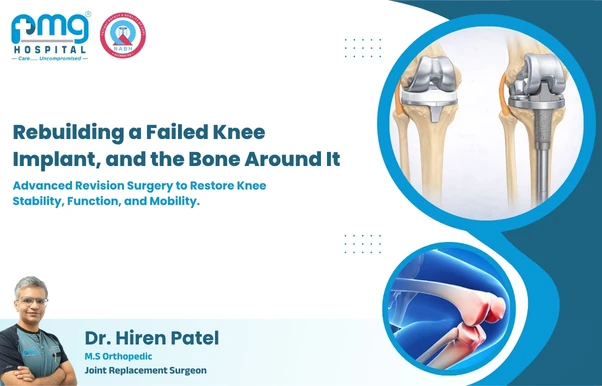
The amount of healthy bone left when the knee is assessed has a major influence on how a revision goes. Bone that has been lost does not grow back and has to be replaced with metal augments, cones or graft, which is why a knee with suspected loosening should be assessed early rather than once walking has become very difficult.
Diagnosis
Is the Implant Really the Problem?
A painful knee replacement has not always failed. The trouble may lie in the lower back, the hip, the soft tissues of the knee or a small, sensitive nerve swelling (neuroma) in the scar. Replacing an implant that is well fixed and well aligned, without a clear cause for the pain, rarely helps. The first task is therefore to find out whether the implant is at fault.
| Test | What it shows |
|---|---|
| X-rays taken months or years apart | Changes over time that suggest loosening or wear |
| Blood tests for inflammation | Raised markers that may point to infection |
| Joint fluid sample (aspiration) | Whether bacteria are present, and which antibiotics would work |
| CT scan | How much bone has been lost, for planning the reconstruction |
Causes
Reasons a Knee Replacement Fails
| Reason | Typical signs | What the revision does |
|---|---|---|
| Loosening | Pain on standing and walking; changes on serial X-rays | Takes out the loose parts and anchors new, stemmed components in firm bone |
| Wear of the plastic insert | Swelling, a feeling of instability, wear seen on X-ray | Exchanges the worn insert and restores stability |
| Infection | Pain, warmth, raised blood markers, bacteria in the joint fluid | Clears the infection, often in two stages |
| Instability | The knee gives way | Uses a more constrained implant to provide the support that the ligaments no longer give |
| Stiffness or malalignment | Poor bending, or a leg that will not straighten | Corrects alignment, releases tight tissues and repositions the implant |
| Periprosthetic fracture | The bone next to the implant has broken, often after a fall | Repairs the break, revising the implant with longer stems if it has come loose |
Who it suits
When Revision Is Usually Considered
- Loosening or wear confirmed on serial X-rays
- Ongoing pain, instability or giving way after a knee replacement
- Infection around an existing implant
- Stiffness or malalignment after an earlier knee replacement
- A fracture around the implant
A painful knee with a firmly fixed, correctly aligned implant and no identified cause is usually not helped by revision.
The operation
Revision Knee Replacement Operation in Ahmedabad: Step by Step
Every revision at PMG Hospital starts from two facts: the reason the original implant failed, and the amount of sound bone still present. The usual stages are:
- 1Work-up: blood tests, joint fluid testing and a CT scan where bone loss needs measuring.
- 2Removal of the failed components while keeping the remaining bone intact as far as possible.
- 3Rebuilding of lost bone with metal augments, cones or bone graft.
- 4Fixing the revision components in place, often with stems and more constrained designs, to restore stability and alignment.
Implant Parts Used in Revision
| Part | Purpose |
|---|---|
| Stems | Rods that pass further up the femur or down the tibia to find solid bone for anchorage |
| Augments and cones | Metal pieces that fill spaces where bone has been lost |
| Constrained designs | Give stability when the knee’s own ligaments can no longer do so |
Revision for Infection
When infection is the cause, treatment is often staged. Stage one takes the infected implant out and places a temporary spacer, and antibiotics are given. Stage two follows when repeat tests suggest the infection is under control, and the definitive revision implant goes in. An infection found early can sometimes be treated without removing the implant, which is why an early, accurate diagnosis matters.
Expectations
What a Revision Can Achieve, and Its Limits
| A revision aims to | Points to understand |
|---|---|
| Relieve pain caused by a loose, worn or badly positioned implant | It is a longer operation with more risk than a first knee replacement |
| Restore stability to a knee that gives way | Bending is often less than after a well-functioning first replacement |
| Correct alignment that was not right after the first operation | The new implant is not expected to last as long as a first implant |
| Clear infection around an implant | Recovery is slower, and weight-bearing may be limited at first |
| Rebuild lost bone with augments, cones or grafts | The more bone lost beforehand, the greater these limits tend to be |
Recovery
Recovery After a Revision
| When | What usually happens |
|---|---|
| Days 0–3 | Getting out of bed is more gradual than after a first replacement; weight-bearing may be limited on purpose |
| Days 5–10 | The usual time in hospital, as the wound and general recovery need longer |
| Weeks 2–6 | Partial weight-bearing continues where bone graft or augments were used; physiotherapy builds up in stages |
| Months 2–4 | The walker or stick is phased out at a pace that depends on what was rebuilt |
| Months 3–6 | Rehabilitation continues; final function is usually reached in this period |
Risks
Risks of Revision Surgery
- Longer time under anaesthesia, and greater bleeding, compared with a primary knee replacement
- A higher chance of infection
- Damage to a nerve or artery, because scar tissue makes the structures harder to see
- The bone breaking as the old components are taken out
- Ongoing pain or stiffness in some patients
These risks are worth accepting when the implant has clearly failed, but not when the pain has a different cause. This is why so much attention is given to the tests before surgery.
Cost
Revision Knee Replacement Surgery Cost in Ahmedabad
- The amount of bone that has to be rebuilt
- Which special components are required (stems, cones, augments, constrained designs)
- One operation, or two stages for infection
- Theatre and anaesthesia time
- The room category and length of stay
- Physiotherapy and follow-up visits
Revisions are generally costlier than primary knee replacements, and the figure differs widely between patients. PMG Hospital provides a written, itemised estimate after the work-up and before admission. Check insurance cover with your insurer.
Questions
Questions to Ask a Revision Knee Replacement Doctor in Ahmedabad
Before agreeing to a revision, it helps to ask:
- Has the cause of the pain been confirmed, and has infection been ruled out?
- How much bone has been lost, and how will it be rebuilt?
- Will the revision be done in one operation or two?
- How long will weight-bearing be limited?
- What result is realistic for my knee?
First visit
Records That Help Plan a Revision
- The operation notes from the first knee replacement
- The make and model of the implant, from its label or record if you have it
- All earlier knee X-rays, in date order
- Reports of any joint fluid tests or cultures
- A list of current medicines
The care team
Revision Knee Replacement Surgery Doctor in Ahmedabad
People searching for a revision knee replacement surgery doctor in Ahmedabad usually need an orthopaedic surgeon whose arthroplasty (joint replacement) training extends to redo operations on the knee. Because a revision can combine taking out an old implant, rebuilding lost bone and treating infection, more disciplines tend to be involved than in a first knee replacement.
| Doctor or therapist | When they are involved | Role |
|---|---|---|
| Orthopaedic surgeon | Throughout | Works out why the first implant failed, plans the bone reconstruction and revision components, and carries out the operation |
| Radiologist | Before surgery | Compares X-rays taken over time and reports the CT scan used to measure bone loss |
| Microbiologist or infectious-disease physician | When infection is suspected or confirmed | Identifies the bacteria from joint fluid or tissue samples and advises on which antibiotics to use and for how long, including the gap between two stages |
| Physician or cardiologist | Before and after surgery | Prepares older patients and those with heart, kidney or sugar problems for a longer operation, and manages these conditions during the stay |
| Anaesthetist | Day of surgery | Plans anaesthesia and pain relief for a lengthier procedure, and prepares for the greater blood loss a revision can involve |
| Physiotherapist | From the first days for several months | Shapes exercises around any limit on weight-bearing, moving from a walker to a stick as the reconstruction allows |
With this many people involved, it is sensible to ask at the outset who will coordinate your care during the hospital stay and through the months of rehabilitation.
Surgeon
Who Performs the Operation
At PMG Hospital, Gota, revision knee replacement is performed by:
| Field | Detail |
|---|---|
| Surgeon | Dr. Hiren Patel |
| Qualifications | MBBS, MS (Ortho), International Fellowship in Joint Replacement |
| Medical college | B.J. Medical College, Ahmedabad (MBBS and MS (Ortho)) |
| Role at PMG Hospital | Director & Head Joint Replacement Surgeon |
| Registration | Registered Medical Practitioner; Gujarat Medical Council Reg. No. G-20583 |
| OPD | Monday to Saturday, 10:00 AM to 8:00 PM; Sunday by appointment |
Hospital
Where the Operation Takes Place
Knee replacement is carried out at PMG Hospital, Gota, Ahmedabad. Services relevant to knee replacement include:
- Orthopaedic OPD: Monday to Saturday, 10:00 AM to 8:00 PM; Sunday by appointment
- Emergency and trauma care, available 24×7
- Physiotherapy at the hospital
FAQs
Common Questions
More on this site: Revision of hip, knee and shoulder replacements·Total knee·Partial knee·All knee replacement types
Contact
Reaching PMG Hospital
Address
PMG Hospital (PMG Orthopedic Hospital)
3rd Floor, Athena Avenue, B/H Jaguar Showroom, Krishna Hardware Road, Nr. Eulogia Inn Hotel, S.G. Highway, Gota, Ahmedabad, Gujarat 382481
- Phone
- +91 96625 91666
- Phone and WhatsApp
- +91 96627 70141
- OPD
- Monday to Saturday, 10:00 AM to 8:00 PM; Sunday by appointment
- Emergency and trauma care
- 24×7
Get in touch
Call or send your reports, or open the hospital’s location in Google Maps.
Medically reviewed by Dr. Hiren Patel, MS (Ortho.), Joint Replacement Surgeon, PMG Hospital, Ahmedabad.