
Partial Shoulder Replacement (Hemiarthroplasty) in Ahmedabad, Gujarat
Recreating Only the Ball, Keeping Your Own Socket
A partial shoulder replacement, also called a hemiarthroplasty, swaps the damaged humeral head, the rounded top of the arm bone, for an artificial one while your own socket stays in place. It is mainly used when the ball has collapsed because of avascular necrosis, or has broken in a way that cannot be fixed, while the cartilage of the socket is still healthy. The new metal head, held by a stem in the arm bone, moves against the natural socket. At PMG Hospital in Gota, Ahmedabad, the usual hospital stay is about two to three days. A sling is used for roughly the first three to four weeks, and strengthening usually starts from about six weeks (six to eight weeks after a fracture).
How it works
How a Partial Shoulder Replacement Works
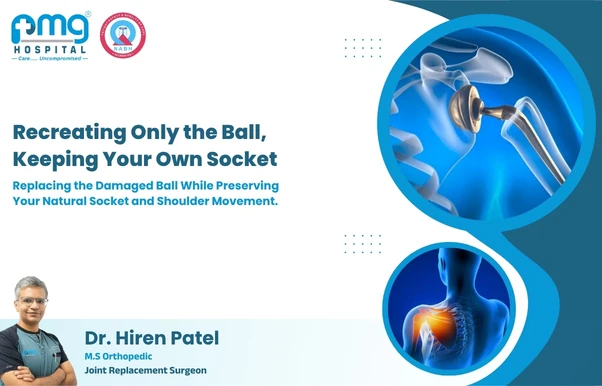
The shoulder is a ball-and-socket joint. In a partial replacement, the surgeon removes the worn or broken humeral head and fits a metal replacement, anchored by a stem in the bone’s hollow centre. The socket on the shoulder blade is left untouched, so the new metal head moves against your own socket cartilage.
This approach works only when the problem is limited to the ball. If the socket is also worn, the metal head rubbing on damaged cartilage tends to leave pain behind.
The choice
Partial or Total? The Socket Decides
| Point to consider | Favours a partial replacement | Favours a total replacement |
|---|---|---|
| Socket cartilage | Healthy or only mildly worn | Clearly worn by arthritis |
| Socket bone | Too thin to hold a socket component safely | Strong enough for a socket component |
| Usual cause | Avascular necrosis, or a complex fracture of the upper arm bone | Osteoarthritis affecting both surfaces |
| Age and activity | Often a younger person, to preserve the socket | Any age, once both surfaces are worn |
| Long-term point | No socket component to loosen, but the natural socket may wear | The socket component can loosen over the years |
Who it suits
Who May Be Suited to a Partial Shoulder Replacement?
- Avascular necrosis of the humeral head with a healthy socket
- A complex fracture of the upper arm bone that cannot practically be fixed with plates or screws
- Arthritis limited mainly to the ball side of the joint
- A younger person in whom keeping the natural socket is preferred
In older people with a complex fracture, or when the rotator cuff is not working, a reverse shoulder replacement is often more suitable, because it depends less on the cuff and on the broken pieces healing.
The operation
Partial Shoulder Replacement Operation in Ahmedabad: Step by Step
If a partial shoulder replacement operation in Ahmedabad is planned for you, these are the main steps at PMG Hospital:
- 1X-rays and scans confirm that the cartilage of the socket is still healthy.
- 2The damaged humeral head is removed.
- 3A metal head on a stem, sized to match your own anatomy, is fixed in the arm bone.
- 4After a fracture, the broken bony prominences where the rotator cuff tendons attach (the tuberosities) are repaired around the implant.
Expectations
Possible Benefits and Limitations
| Possible benefits | Limitations |
|---|---|
| Keeps your own socket | The natural socket can wear over the years and cause pain |
| No socket component that could loosen later | Not suitable when the socket is already worn |
| A later change to a total or reverse replacement is usually possible | After a fracture, the result depends partly on the tuberosities healing |
| Avoids an early socket implant in a younger person | Pain relief may be less complete than with a total replacement when the socket has some wear |
Recovery
Recovery Timeline After a Partial Shoulder Replacement
| When | What usually happens |
|---|---|
| Weeks 0–3 | Sling support, with gentle assisted movements from early on to prevent stiffness |
| Weeks 3–6 | The sling is gradually stopped; assisted movement increases under supervision |
| Weeks 6–12 | You start moving the arm on your own, with light strengthening; reaching and dressing become easier |
| Months 3–6 | Strength keeps improving as the shoulder settles |
After a fracture, the sling is often used for around four weeks, movement starts more cautiously, and strengthening usually begins between six and eight weeks.
Risks
Risks to Discuss Before Surgery
- Gradual wear of your own socket against the metal head, which can cause pain
- Stiffness
- Infection around the implant
- Instability of the joint
- After a fracture, the tuberosities failing to heal in the right position
- Injury to a nerve around the shoulder (uncommon)
- A break in the arm bone during or after surgery
Cost
Partial Shoulder Replacement Surgery Cost in Ahmedabad
The cost of partial shoulder replacement surgery in Ahmedabad depends mainly on:
- The implant used
- Any extra fixation needed after a fracture
- The room category and the number of days in hospital
- Scans before surgery, physiotherapy and follow-up visits
As the socket is left alone, a partial replacement usually costs less than a total or reverse replacement. PMG Hospital gives a written, itemised estimate after the assessment. Check your cover with your insurance provider.
Questions
Questions to Ask a Partial Shoulder Replacement Doctor in Ahmedabad
Whichever partial shoulder replacement doctor in Ahmedabad you consult, these questions help to check whether the operation suits your shoulder:
- Is my socket cartilage healthy enough to keep?
- Would a total or a reverse replacement suit me better?
- Is my rotator cuff working?
- If the socket wears later, what would the next step be?
- How long will I need the sling, and when does strengthening start?
The care team
Partial Shoulder Replacement Surgery Doctor in Ahmedabad
Any partial shoulder replacement surgery doctor in Ahmedabad in charge of your care should be an orthopaedic surgeon with training in arthroplasty (joint replacement), ideally with a focus on the shoulder. That surgeon judges whether your socket can be kept and does the operation itself, while a small team looks after the other parts of your treatment:
| Stage | Who is involved | What they do |
|---|---|---|
| First assessment | Orthopaedic surgeon | Examines the shoulder, tests the rotator cuff and weighs a partial against a total or reverse replacement |
| Scans | Radiologist | Interprets the shoulder X-rays and CT images showing the socket cartilage, the bone stock and any fracture pattern; an MRI is sometimes added to study the cuff or the blood supply of the ball |
| Fitness for surgery | Physician or cardiologist | Checks sugar control, blood pressure, the heart and any blood-thinning medicines; this matters most for an older person with a fracture |
| Day of surgery | Anaesthetist | Gives general anaesthesia, usually adding an injection near the nerves above the collarbone (a nerve block) that keeps the arm numb and comfortable for some hours after surgery |
| Operation | Orthopaedic surgeon | Replaces the humeral head and, after a fracture, secures the tuberosities around the implant |
| Rehabilitation | Physiotherapist | Teaches safe, gentle movement while the sling is in use, then guides strengthening once the surgeon allows it |
Bring your earlier X-rays, scan reports and a written list of current medicines to the first appointment, so that everyone on the team plans from the same information.
Surgeon
Who Performs the Operation
At PMG Hospital, Gota, partial shoulder replacement (hemiarthroplasty) is performed by:
| Field | Detail |
|---|---|
| Surgeon | Dr. Hiren Patel |
| Qualifications | MBBS, MS (Ortho), International Fellowship in Joint Replacement |
| Medical college | B.J. Medical College, Ahmedabad (MBBS and MS (Ortho)) |
| Role at PMG Hospital | Director & Head Joint Replacement Surgeon |
| Registration | Registered Medical Practitioner; Gujarat Medical Council Reg. No. G-20583 |
| OPD | Monday to Saturday, 10:00 AM to 8:00 PM; Sunday by appointment |
Hospital
Where the Operation Takes Place
Partial shoulder replacement is carried out at PMG Hospital, Gota, Ahmedabad. Services relevant to partial shoulder replacement include:
- Orthopaedic OPD: Monday to Saturday, 10:00 AM to 8:00 PM; Sunday by appointment
- Emergency and trauma care, available 24×7
- Physiotherapy at the hospital
FAQs
Common Questions
Related shoulder pages: Total shoulder replacement·Revision and reverse shoulder replacement·Shoulder replacement overview
Contact
Reaching PMG Hospital
Address
PMG Hospital (PMG Orthopedic Hospital)
3rd Floor, Athena Avenue, B/H Jaguar Showroom, Krishna Hardware Road, Nr. Eulogia Inn Hotel, S.G. Highway, Gota, Ahmedabad, Gujarat 382481
- Phone
- +91 96625 91666
- Phone and WhatsApp
- +91 96627 70141
- OPD
- Monday to Saturday, 10:00 AM to 8:00 PM; Sunday by appointment
- Emergency and trauma care
- 24×7
Get in touch
Call or send your reports, or open the hospital’s location in Google Maps.
Medically reviewed by Dr. Hiren Patel, MS (Ortho.), Joint Replacement Surgeon, PMG Hospital, Ahmedabad.